Protoplanets

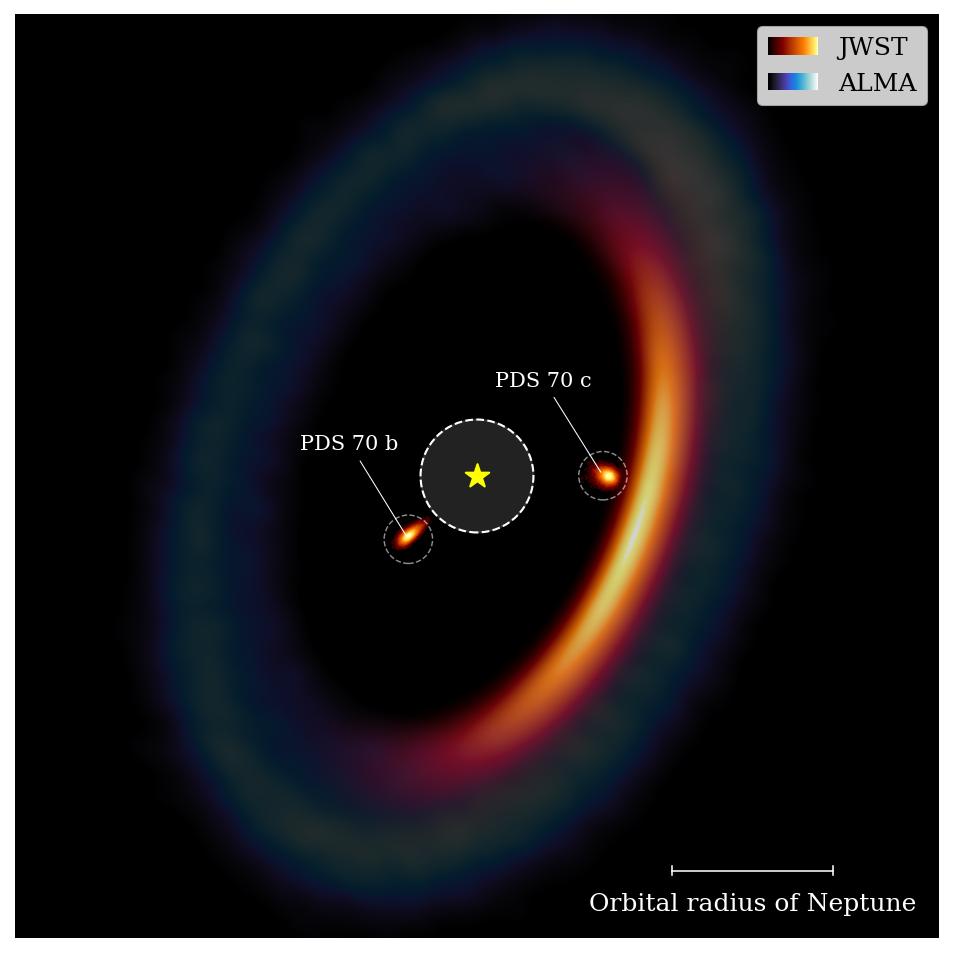
The PDS 70 system, showing two forming planets inside a circumstellar disk

Image: Blakely et al. (2024)

Studying planet formation tells us why planetary systems are so diverse: which worlds can form, where they form, and how their first few million years shape what they later become. By observing planets while they are still growing, we can test these ideas directly and work towards the most fundamental question: ultimately, how did we get here?

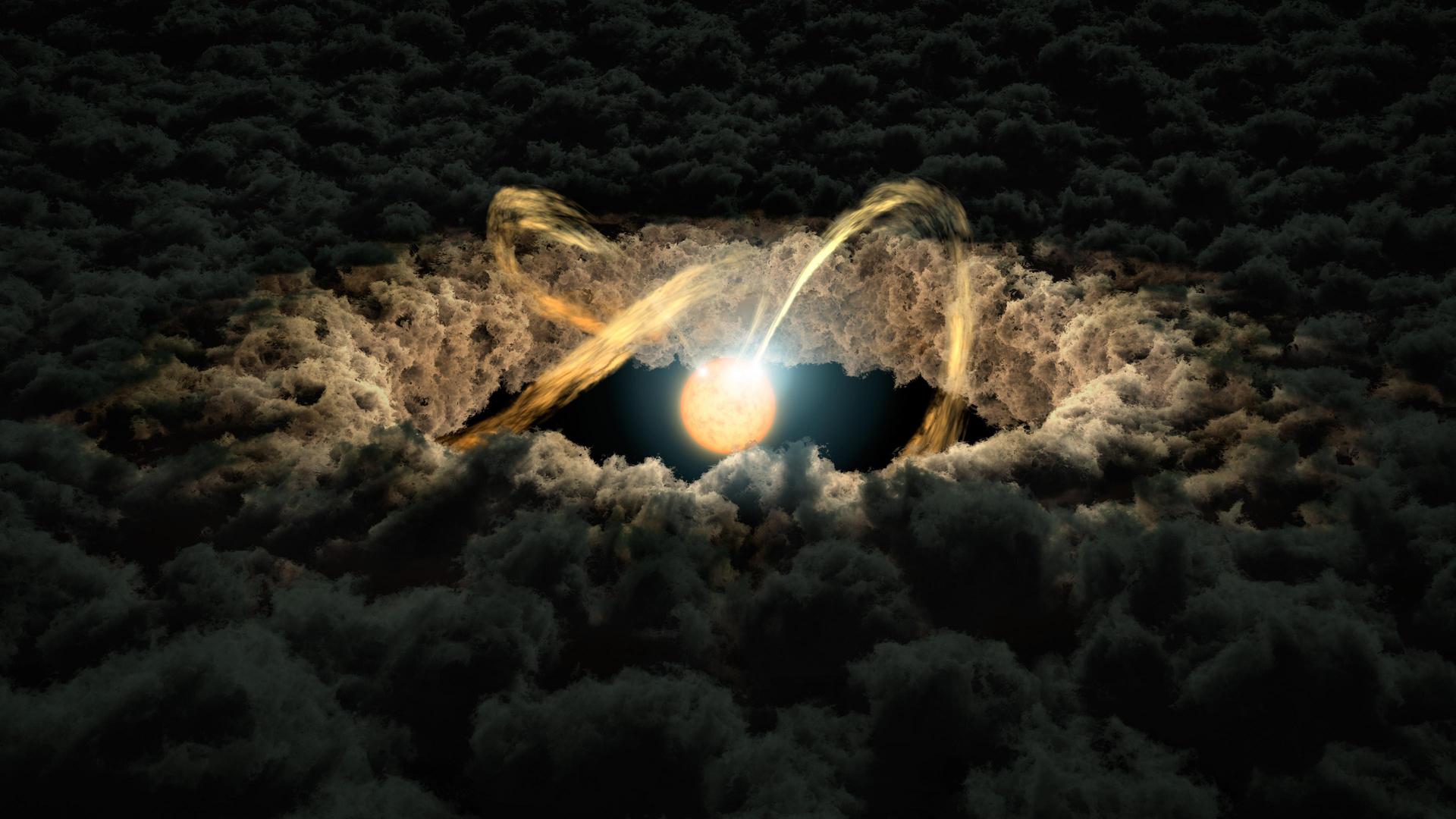
More concretely, I connect young giant planets with the disks in which they form. A planet can carve gaps, launch spirals, and change the flow of gas and dust; the disk, in turn, controls how the planet gains mass and can hide it from our view. Studying the two together reveals this interplay.

I combine several instruments, including SPHERE, MagAO-X, JWST/NIRCam, and JWST/MIRI, to search from optical to mid-infrared wavelengths. The thermal glow of a young planet reveals the heat left by its formation, while emission from infalling gas traces ongoing accretion. Together, these signals tell us where planets are forming and how quickly they are growing.
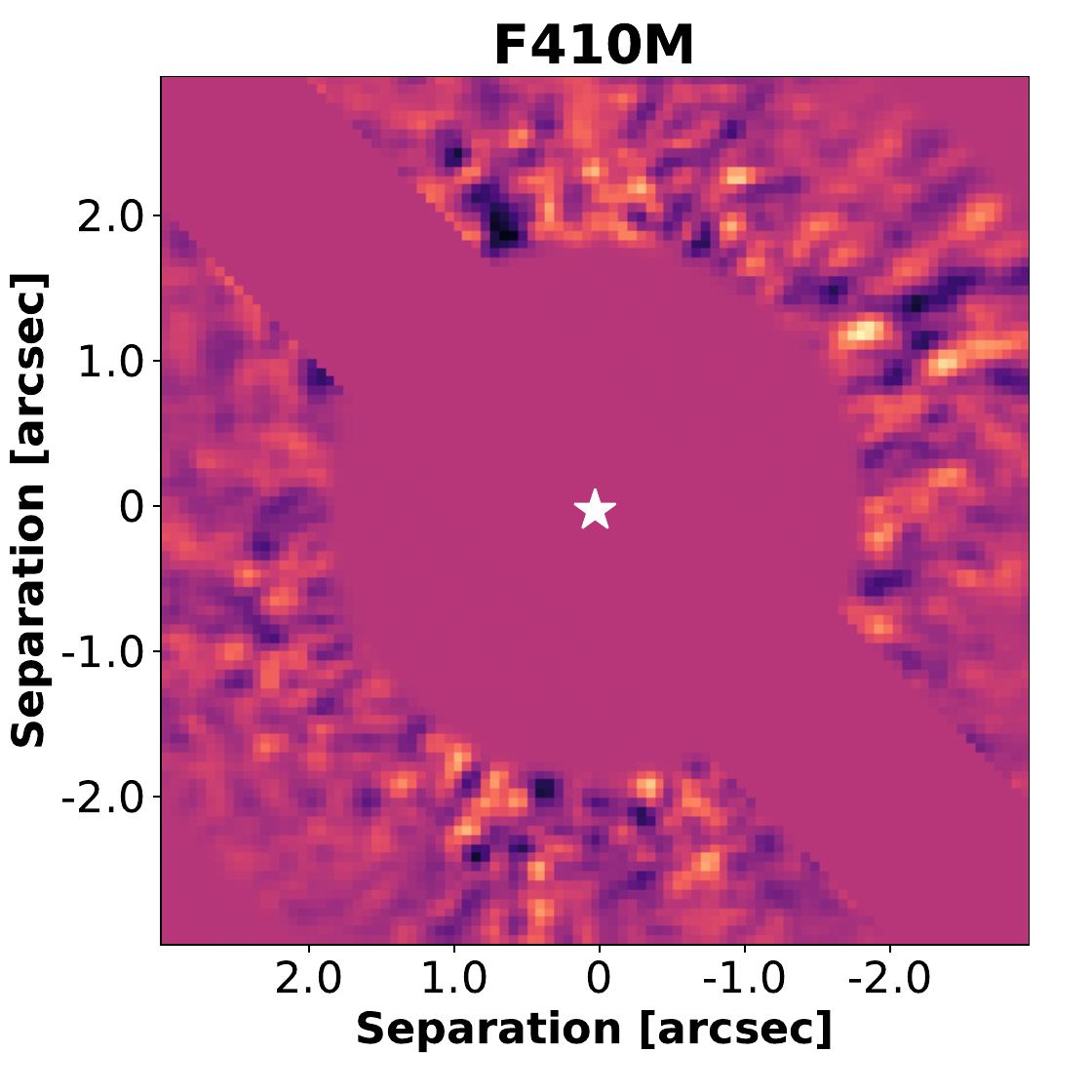
JWST/NIRCam constraints on a companion candidate around SAO 206462Figure: Cugno et al. (2024)

Imaging the youngest planets with JWST

With JWST, I use NIRCam and MIRI to search for young giant planets at wavelengths where they should glow. Our NIRCam images of SAO 206462 revealed its spiral disk, set deep limits on unseen planets, and uncovered a companion candidate. In 2026, we used MIRI to target five disks with possible planet signatures in their gas. We found no point-like planets, but detected extended emission from three disks, showing that protoplanets remain elusive even at long wavelengths.

Molecular mapping analysis of the PDS 70 systemFigure: Cugno et al. (2021)

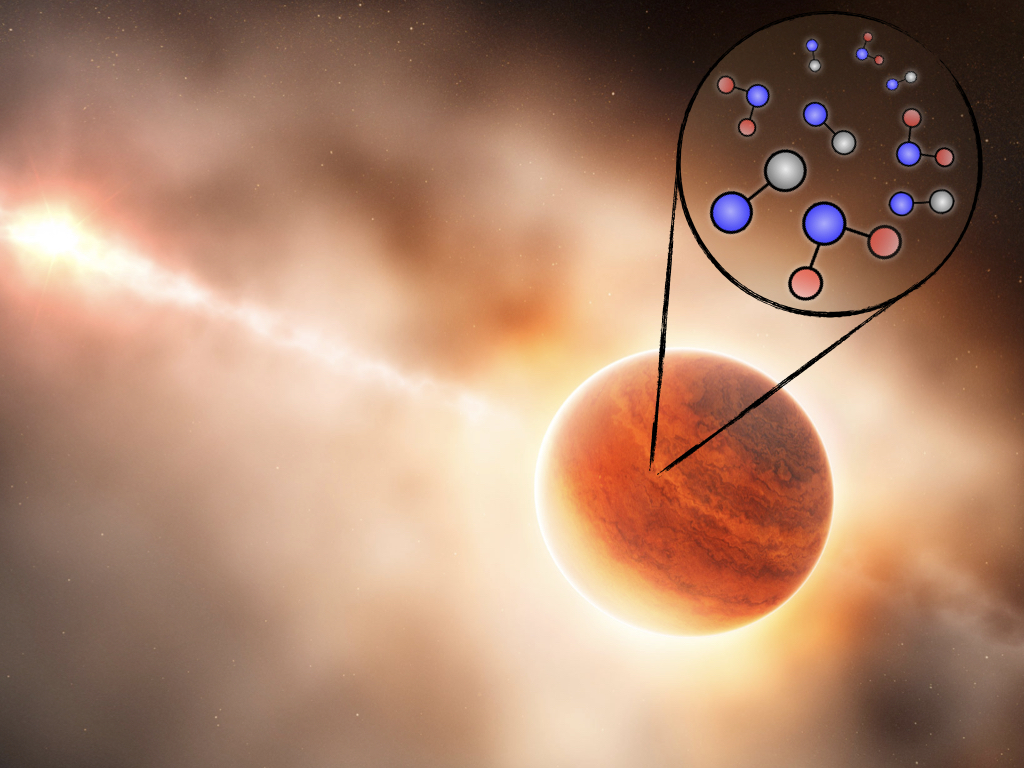
Searching for molecular absorption features from a forming planet

We used molecular mapping to search for absorption features in the atmosphere of the forming planet PDS 70 b. We did not identify any molecular signal, and explored several possible explanations for why these features may be hidden or absent.

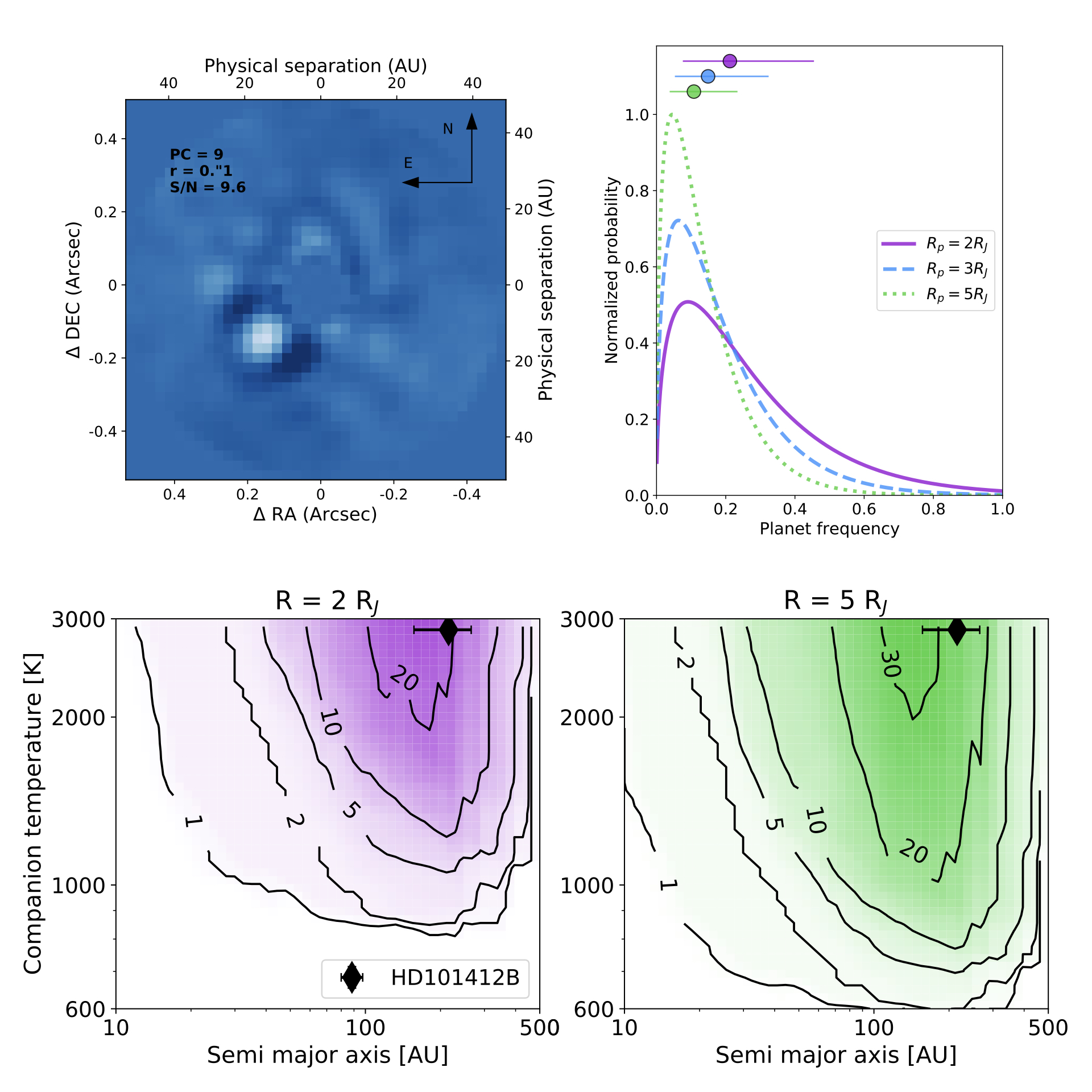
Detection limits from the NaCo-ISPY search for forming planetsFigure: Cugno et al. (2023)

The ISPY search for forming planets in the L' band

Within the NaCo-ISPY survey, we observed 50 protoplanetary disks searching for embedded, forming protoplanets. In 2019, we discovered a new (sub-) stellar companion to R CrA. In 2023, we published the final results of the survey, with a particular focus on the broader population of forming planets.

The first surveys to search for accreting protoplanets

As gas falls onto a forming giant planet, it can produce bright Hα emission that high-contrast instruments can isolate from the host star. I helped carry out some of the first dedicated surveys for this signal with VLT/SPHERE. More recently, rather than surveying a sample, we used MagAO-X and HST to test the specific planet candidate in the AS209 disk. We detected no Hα emission there, suggesting that dust near the planet may strongly obscure its accretion signal.