Protoplanetary disks are the reservoirs of gas and dust from which planets are built. Their rings, gaps, and spirals preserve clues to where planets are forming and how they exchange material with their surroundings. Understanding these disks is therefore essential if we want to explain the remarkable variety of planetary systems we observe.
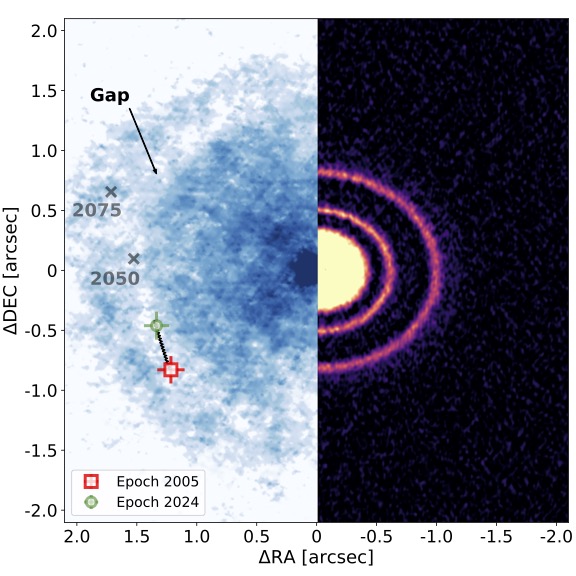
A central part of my work is developing a new technique that uses background stars as probes. As their light passes through a disk, changes in its colour reveal how much material lies along the line of sight—much like transmission spectrophotometry, but with a protoplanetary disk in the foreground. I also use MagAO-X to take optical images of disks in scattered starlight, revealing fine structures in their surfaces.